
Thermtec VENTUS review: The ultimate thermal imaging binoculars?
17.04.2026
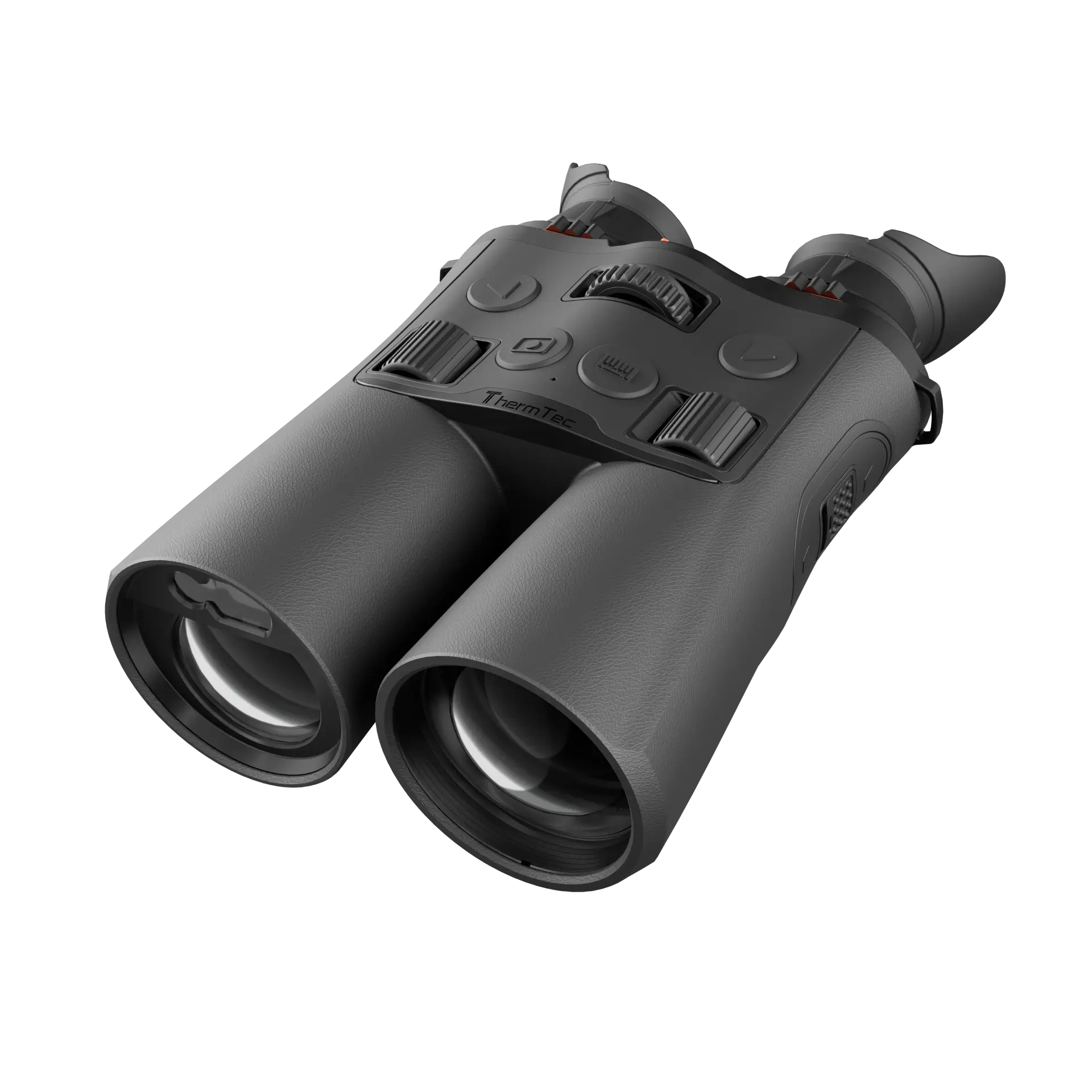
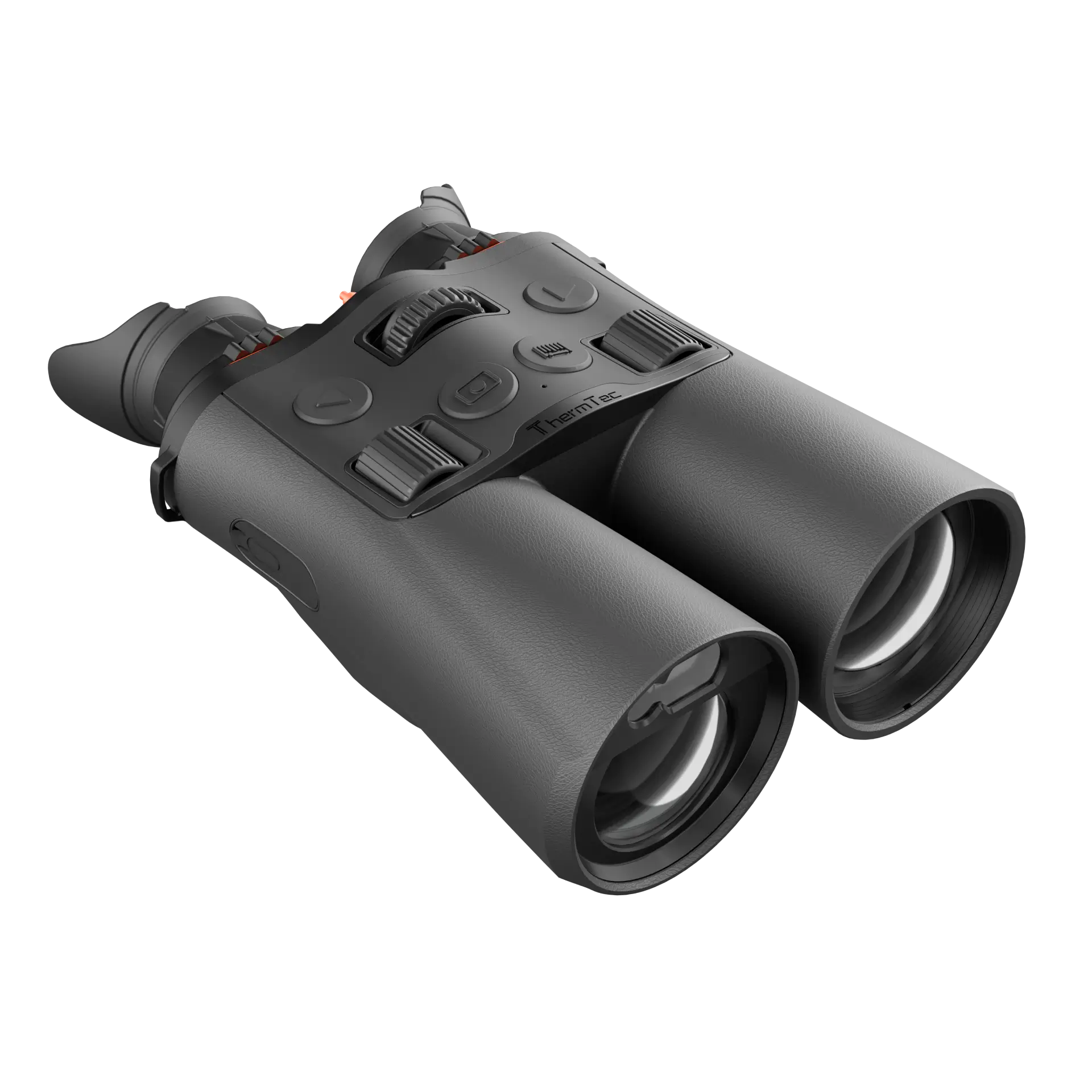
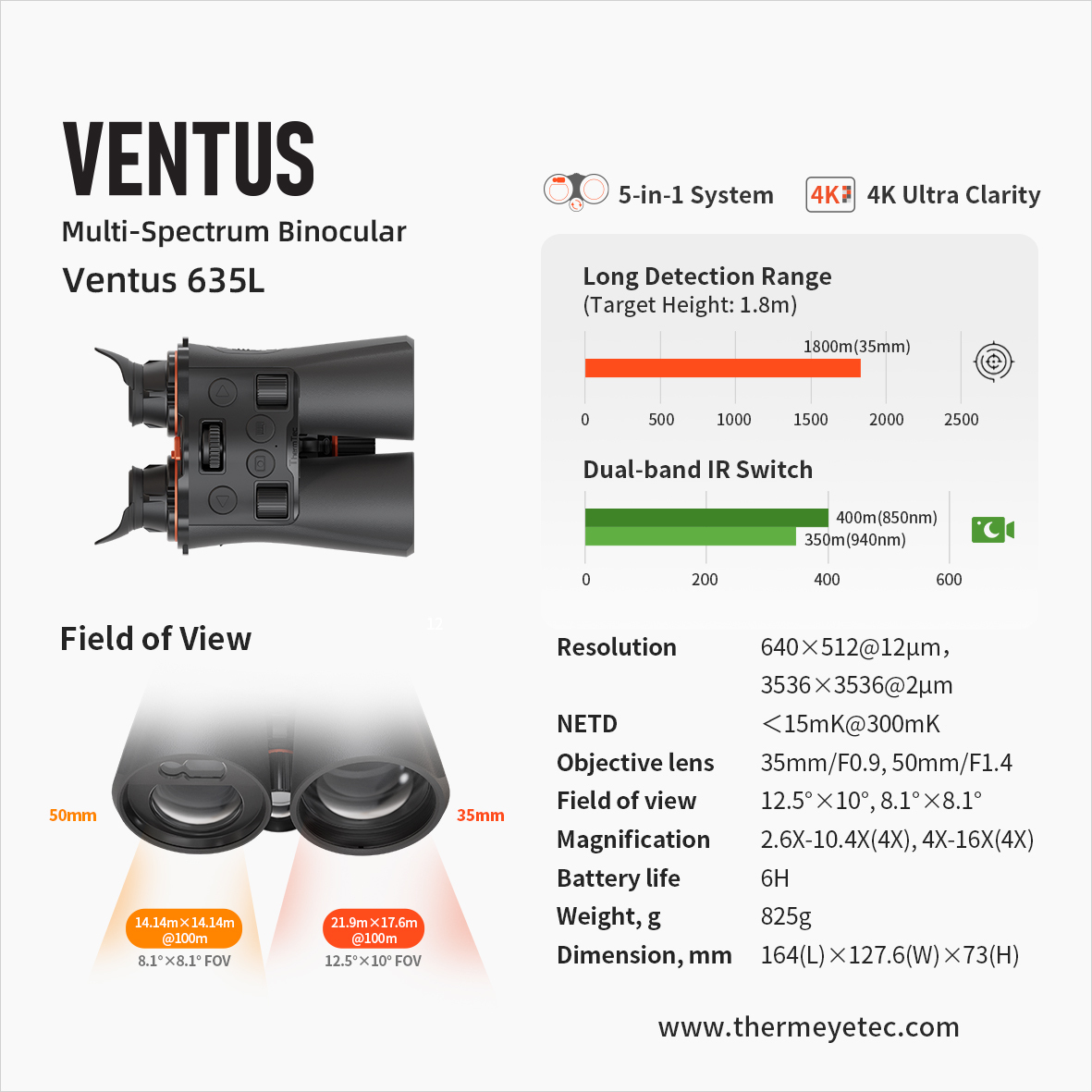
ThermTec deliberately took its time with multispectral binoculars – and the result is impressive. The Ventus 635L combines 35mm thermal imaging optics , 4K night vision with a switchable IR illuminator, and a daylight channel in a single handheld device. This test, based on real field observations, reveals the device's practical performance, its strengths, and areas for improvement.
What does the term multispectral mean?
Unlike a conventional thermal imaging camera, the Ventus can visualize objects in multiple ways: during the day, it operates in the normal light spectrum (400–780 nm) , at dusk it switches to the active near-infrared range – and if dense vegetation blocks the infrared image, the thermal imaging channel is simply activated . This is complemented by a laser rangefinder . Multispectral here truly means: all relevant viewing ranges are covered, all in one device.
The Ventus is not technically a binocular in the classic sense – it has two eyepieces and OLED displays, but does not produce a stereoscopic 3D image. The correct term would be "biocular." However, in everyday use and within the industry, "multispectral binocular" has become the standard term.
Infrared heaters: The unique selling point
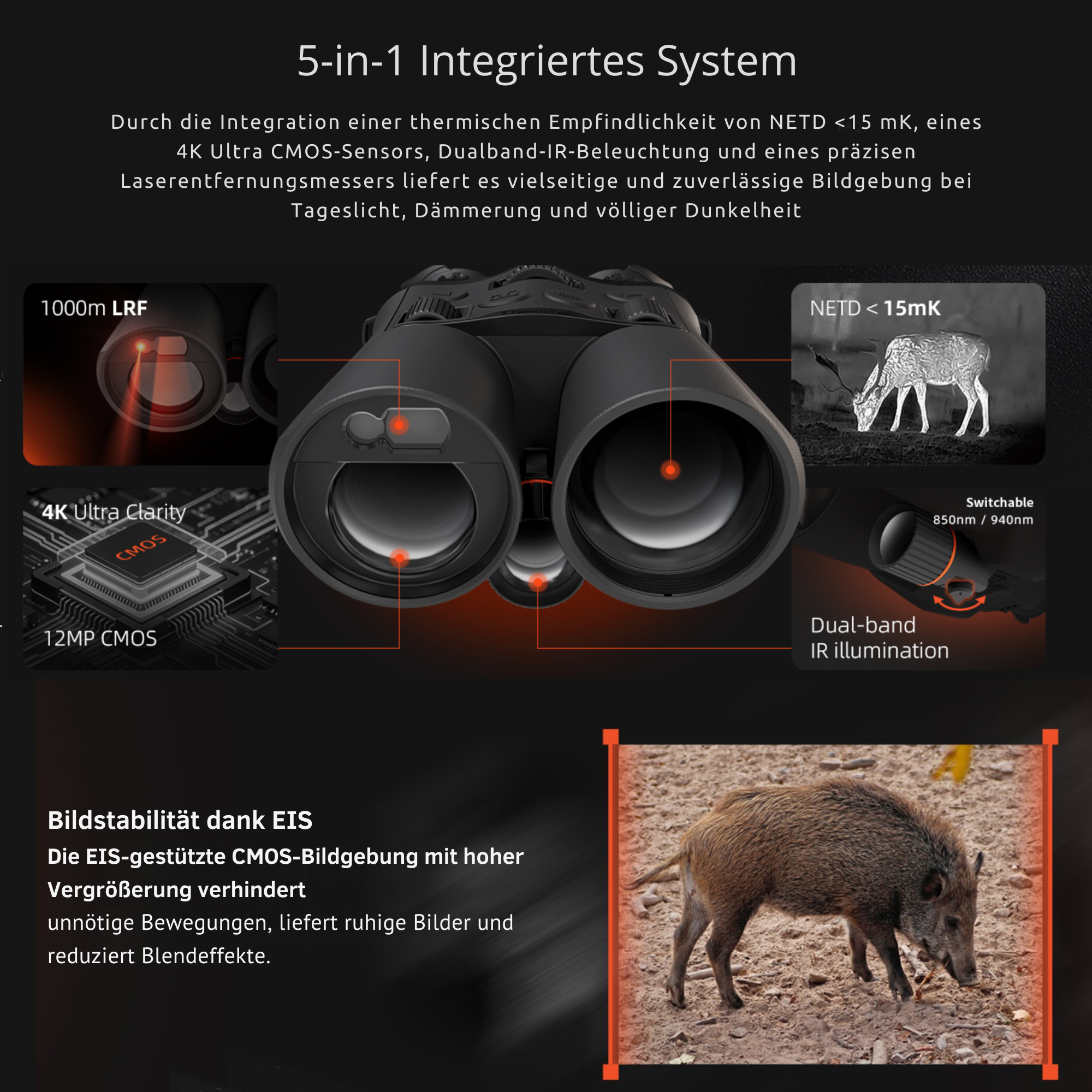
The crucial difference compared to all competitors: The IR emitter of the Ventus 635L can be switched between two wavelengths via a switch – without tools, without conversion, directly in the field.
In practical testing, this difference was immediately noticeable: A young wild boar at around 30 meters reacted instantly when switching from 940 to 850 nm – it looked up. After switching back to 940 nm, it lost interest again. There's hardly a more direct demonstration of the practical benefits. With competing devices, this choice has to be made before purchase or before the hunt – or you have to lug around a separate spotlight. With the Ventus, you decide situationally with a switch . If you don't need the spotlight at all, you simply unscrew it and leave it at home.
Operation and ergonomics
First steps – practice beforehand is essential
The Ventus is no longer a classic thermal imaging device, but a more complex system with many modes. Anyone using the device for the first time while hunting from a stand will need some time to familiarize themselves with it. Practical advice: before the first use in the field, carefully go through all the functions – ideally in daylight or at a wild boar park.
Anyone encountering a pack of wolves for the first time in pitch-black darkness is clearly at a disadvantage with an unfamiliar device. It's not rocket science – but be sure to cycle through all the modes before heading out.
Interpupillary distance and diopters – adjust first
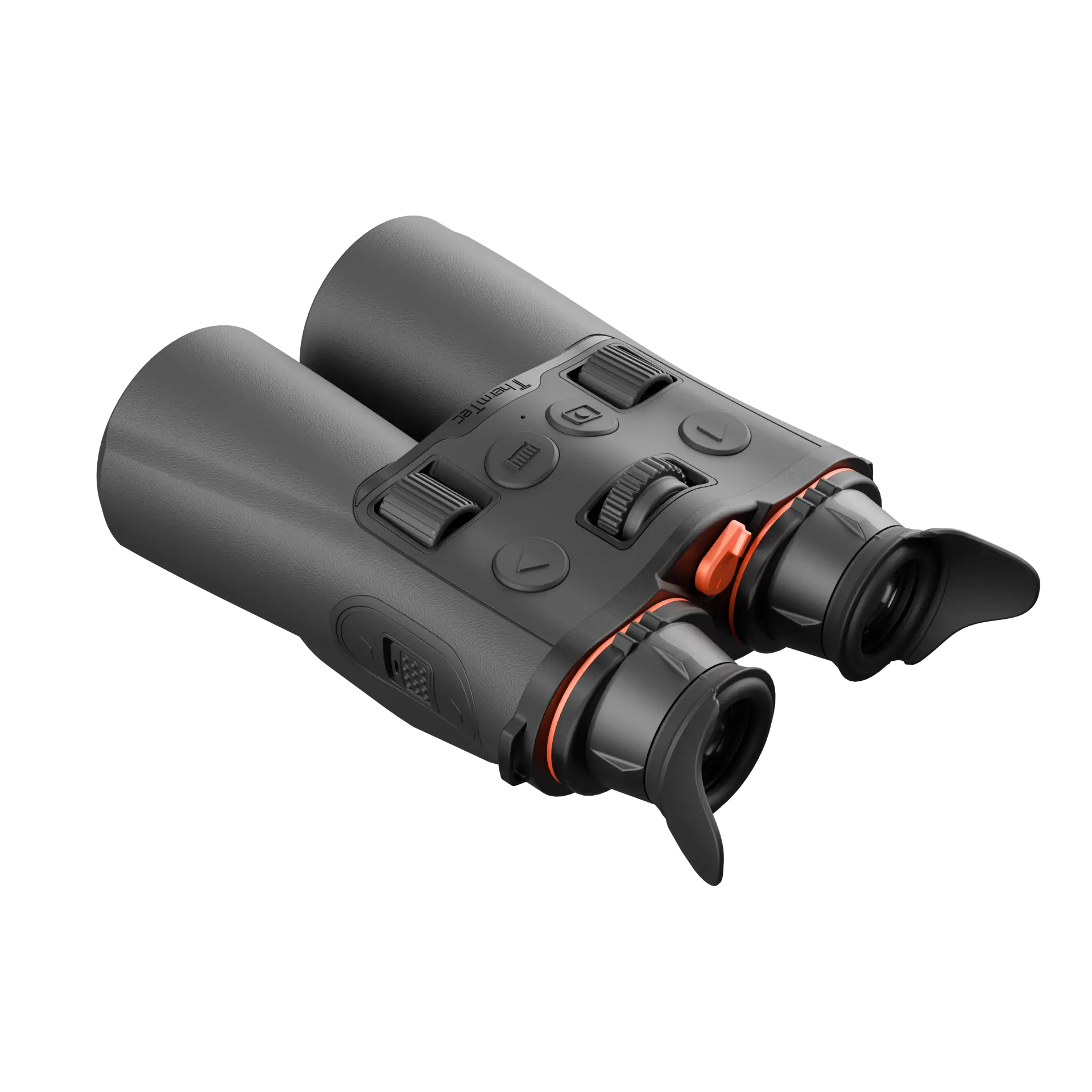
Adjust the interpupillary distance of the two eyepieces right at the beginning – otherwise you'll get double images. Then adjust both diopter wheels separately. It's recommended to access a menu and use the text as a reference point to ensure that both eyepieces are truly in focus.
Four main buttons, two focus wheels
The four main control buttons are located at the top, logically arranged – unfortunately, they are not freely configurable . A particularly well-designed feature is the two separate focus wheels for the thermal imaging and night vision channels. The display always shows which wheel is currently active. Pressing the large control wheel switches between channels, while rotating it zooms up to 4x digitally in both channels. A long press accesses the menu.
Proximity sensor and standby
The proximity sensor automatically switches the device on and off when you take it away from your eyes – handy because it prevents you from accidentally filming the floor for hours. One minor annoyance: video recording stops automatically when changing channels. That's a shame if you're recording at that moment.
The first time you connect to the app, the searchlights must be switched on – not in standby mode – otherwise the Wi-Fi network will not be visible. Once connected, the app will continue to run even in standby mode.
Battery power supply – well-designed and practical
The Ventus runs on two standard 21650 batteries . No proprietary system, no expensive system battery – replacements are readily available everywhere for a small price. The battery compartment is easy to access even in the dark because the batteries are simply inserted crosswise . Polarity doesn't matter as long as they are opposite each other – in the dark, just feel for the notch, insert them, and you're done.
In our test, after almost four hours of intensive use, two out of five battery bars remained. The included second set of batteries easily lasts all night . External USB charging is not supported – but given the battery capacity, it's not necessary.
Simply insert both batteries crosswise – the orientation doesn't matter, as long as they're opposite each other. A really well-thought-out design that makes changing batteries in pitch-black darkness considerably easier.
Night vision and thermal imaging in practice
Thermal imaging: 35 mm, f/0,9
The 35mm thermal imaging optics with f/0,9 It even shows through dense vegetation. In the test, a sounder of wild boar was standing on the other side of a path behind dense bushes – the thermal image still clearly showed them. Night vision would have been useless in this situation: with branches in the foreground, you would only illuminate the vegetation. the Wild Behind it remains invisible..
Night vision: 4K with image stabilization
Image stabilization can be switched between three levels and works in both night vision and daylight channels – but not in thermal imaging. This is due to technical limitations and is hardly a problem in practical use. Handheld shots at 65 m show wild boar in detail , and even with digital zoom, the image remains remarkably steady.
The IR illuminator is set too narrowly: the image then appears overexposed in the center and dark at the edges. Rotate the illuminator's focus so that the entire field of view is evenly illuminated – not just the digitally zoomed section.
Picture-in-picture: both channels simultaneously
The picture-in-picture function , which can display both channels simultaneously, is a truly unique feature. When scanning during the day, this allows you to detect areas hidden behind vegetation using the additional thermal image , areas that you would simply miss with normal binoculars.
Suitability as a substitute for binoculars during the day
At 1,5x digital zoom, the Ventus achieves roughly the magnification of a 7x42 binocular. Naturally, the 4K sensor doesn't reach the image quality of high-end optical glass – but that's not the primary focus. What's crucial is reliable focus : the digital zoom with image stabilization makes a decisive difference here. Holding a 12x binocular steady is nearly impossible, but the Ventus keeps the image steady even at 4x zoom . Add to that the simultaneous laser rangefinder and thermal imaging – no other binocular can offer that.
The Ventus is less suitable for stalking : with both eyes covered and a field of view of only 21,9 m at 100 m, it lacks overview. However, this applies to all devices of this design.
Rating
- IR emitter switchable between 850 / 940 nm – unique
- Ergonomic thumb rests, high-quality finish
- Two separate focus wheels per channel
- Standard 21650 batteries, foolproof insertion
- IP67 – fully weatherproof
- Picture-in-picture of both channels simultaneously
- Image stabilization in 3 levels
- The lens cap is a bit wobbly (a flip cap would be better).
- Channel change stops video recording
- Keys not freely configurable
- No external USB charging
- No white balance preset for daylight
- Limited field of vision (21,9 m / 100 m)
635L or 650L – which model is right?
The Ventus 635L is the right choice for most users. Those who regularly hunt at longer distances and need more detail in their thermal images should consider the Ventus 650L : identical electronics, identical operation, but with a 50mm thermal imaging lens instead of 35mm. This provides a narrower field of view (approx. 15m at 100m) and higher base magnification – ideal for open terrain and long distances . For wooded areas and versatile use, the 635L, with its wider field of view, is the more flexible choice.
The ThermTec Ventus 635L is available at Venari Hunting equipment available – including personal consultation, even outside regular opening hours.
View Ventus 635L For the 650L (50 mm)


