Our recommendations
- Are you looking for an additional device? The PARD NV007SP is the best-selling device in Germany.
- If you are looking for an attachment, we recommend this HIKmicro Cheetah.
At a glance
- If one speaks of “night vision”, one usually means infrared-sensitive tubes or digital devices
- thermal imaging attachments However, they are also capable of night vision!
- Advantage of night vision: Extremely sharp image and therefore easy to address as well as a significantly better spatial perception than with thermal imaging.
- Advantage of thermal imaging: no heat source remains undetected (especially in fog or rain)
- With night vision devices, there is both attachment and attachment technology
Our recommendation for your area? Find out here!
What type of device are you looking for: a handheld device or an attachment?
Night Vision Devices for Hunting: Purchase Guide 2026
Last updated: 01.01.2024/XNUMX/XNUMX
Night vision devices for hunting are manufactured in different forms (attachment or attachment) and with different technologies (tube, digital, thermal imaging). In the following text we give an overview of the night vision devices used today for hunting
Table of Contents
Table of Contents
Overview of current night vision attachments
What questions should you ask yourself when choosing a night vision device?
Choosing the right night vision device depends on the area, typical distances, budget and personal preference. Ultimately, the hunter has to decide between technology and mounting type
Technology: thermal imaging or night vision | Both are “night vision capable”
Installation: Attachment (clamps on the front of the glass) or Post-attachment (clamps on the back of the eyepiece of the glass) | is a thermal imaging device eternity an attachment
Hunting area and distances – At shorter (baiting) and medium hunting distances, the performance of the different technologies is comparable. However, at longer distances (where the hunting area has a high proportion of open fields), it can be advantageous to prefer night vision technology (tube or digital) to thermal imaging technology, as target identification at long distances is more reliable with night vision.
Typical weather conditions – night vision technology is “weather-sensitive.” Fog and rain impair visibility and refract IR light or residual light. Anyone who frequently encounters fog in their hunting area during typical hunting situations should take this into account when choosing night vision technology. Thermal imaging is less affected by these conditions.
Imaging & Response – Do I prefer a “real image” or a heat signature? Night vision provides a real image based on (infrared) light. Thermal imaging, on the other hand, transfers temperature nuances into an image visible to the human eye - so it's not a "real image" but rather an image interpretation by software. Anyone who opts for night vision often attaches importance to a light-based real image, since this image is the only way to really respond precisely, even at greater distances.
tube or digital – Furthermore, a distinction must be made here between digital and tube. With digital night vision, the hunter looks through his glass at a monitor. Here, too, software image processing takes place - but the display comes very close to the "real image". If you also want to exclude this image processing and look directly through your glass into the night, you should definitely take a look at the tube night vision devices. (See also comments below in the text.)
attachment or attachment – Again, in thermal imaging there are only attachments, in night vision there are attachments and attachments. Attachments are significantly cheaper than attachments.
add-on devices – The advantage of additional devices lies in the simple assembly and the low price (starting from EUR 350). Since the devices do not generate any further optical axis, there is no deviation in impact due to the attachment device. There is therefore no need to correct the point of impact, which simplifies operation significantly.
Attachments - Both thermal imaging and night vision attachments are priced well above the attachments. Both technologies have to be zeroed in, whereby the point of impact corrections of night vision devices often have to be made very little or not at all. The advantage of thermal imaging attachment is obvious - the thermal image which makes up the Wildit extremely simplified.
night vision attachments are nowadays mainly recommended for two types of hunters. Either I simply want to have the best performance at long distances when hunting - then a tube night vision attachment is the method of choice, since the best picture at long distances (provided the weather conditions are good) can still be produced with high-quality picture tubes . The other category of hunters are those who are looking for the simplest possible devices for night hunting. So hunters who are less comfortable with digital technology and just want to plug in a device and switch it on. Tube night vision attachments are also particularly recommended for this purpose, since they basically only have an on/off switch and a brightness control for the tube.
Budget – Prices for night vision devices vary. They can be categorized as follows, ranging from relatively inexpensive to expensive: Digital night vision (starting at €500 to €2.000), CRT night vision (starting at €2.000 to approximately €10.000), and thermal imaging clip-on devices (starting at €2.500 to €7.500) – thermal imaging is therefore generally more expensive than night vision. High-performance night vision devices, in turn, are usually significantly more expensive than most thermal imaging clip-on devices.
What makes a good night vision device?
Night vision devices work with light – just like the human eye – only with "residual light." That's why they are also called "low-light amplifiers." Available light is made visible to the human eye via image intensifier tubes or photosensors. Often, the residual light is supplemented by infrared illuminators . There are night vision devices with image intensifier tubes as well as digital night vision devices . Both technologies utilize light extending into the infrared spectrum (from 740 nm to over 1.000 nm) to enable night vision.
Differences between tube technology and digital technology
Tube night vision attachments
Imager tubes image the environment at night in the infrared spectrum, using proven technology that has been perfected to this day. Tube devices are easy to use and often “reduced to the essentials”: assemble, test shoot once, just focus during operation – done. No zeroing, no WLAN, no video recording, no operating menu - just the "essentials".
Tube Quality – The performance of a tube-based night vision attachment is primarily determined by the image intensifier tube. High-quality tubes are capable of producing a bright and high-contrast image even in very low ambient light. The tube generation (see explanations below) and its quality (purity, number of line pairs, and signal-to-noise ratio) are crucial factors in determining tube quality. Please note that image intensifier tubes are unique – each tube has its own characteristics regarding brightness and purity. Many manufacturers therefore classify tubes into different quality grades.
The purity of the picture tube – the fewer (dust) inclusions a tube has, the "better" it is – similar to inclusions in a diamond. Large inclusions (also called "spots") can sometimes impair the shooter's perception and are therefore undesirable.
Line pairs per millimeter (lp/mm) – Image converter tubes have so-called “line pairs,” which describe the equivalent of a screen's pixel density. BUT: More is not always beneficial, because the human eye cannot perceive any further improvement in image quality above approximately 65 lp/mm.
Signal-to-noise ratio (S/N) – A poor signal-to-noise ratio becomes apparent to the hunter when the image appears "snowy," similar to the image noise of a digital camera in low light. The better the signal-to-noise ratio, the less image noise and artifacts appear in low light, and the better it can be used without an additional illuminator.
The optical system – The quality and design of the lens system naturally also influence system performance. Generally speaking, the larger the objective diameter and exit pupil, the more power the image intensifier tube can deliver.
Image quality and user experience of a CRT night vision device: CRT devices offer a very clear and sharp image. The user experience can be described as very "direct." You can tell that you are looking directly through a cathode ray tube and that the image is not affected by image processing. The (infrared) light enters the tube directly, its wavelength is reduced, and then it reaches the eye. The result is a sharp image with no delay. There are also usually no adjustment options on the device (except for brightness control).
Digital night vision attachments
In recent years, digital night vision devices have gained market share. Technically, they work in a similar way to digital cameras. A semiconductor image sensor converts incoming light (in this case up to the infrared range) into an electronic signal, which is processed and displayed on a screen in the device.
Photo Sensor Technology & Resolution – The type and resolution of the sensor play a crucial role in the performance of the digital clip-on camera. A resolution of at least 640 x 480 pixels is now standard for many devices, with some even offering HD resolution (1.024 x 768 pixels). A CMOS sensor is typically used.
Monitor, refresh rate & processor speed – Since the hunter essentially looks through their lens at the screen in digital clip-on devices, the monitor quality and the processor's smooth image processing are crucial. Most modern devices use OLED displays with 1.024 x 768 or 1.280 x 768 pixels. Depending on the device, slight delays may be noticeable during movement or significant changes in brightness.
The optical system – As with a conventional camera, light must be captured through the lens. Generally speaking, the higher the quality and larger the lens, the better the image. This also applies to digital clip-on devices. A large exit pupil also improves the system performance of the device.
Image quality and user experience of a digital night vision device : Digital clip-on devices have a built-in monitor. It's important to understand that you're looking at the monitor through your scope – with all the advantages (various image processing settings, often extras like recording function, color settings, Wi-Fi) and disadvantages (potentially minimal image delays, image noise in low light, "too many settings," possibly a synthetic image quality).
FAQ about night vision attachments
In this case, intent means “in front of the optics”. Night vision attachments are designed in such a way that they can be mounted in front of a (target) optic. Usually for application.*
Attachments clamp onto the scope's eyepiece rather than the front of the scope. Since no second image plane is generated in this way, the point of impact cannot be shifted due to the attachment device.
Both residual amplifying night vision devices and thermal imaging devices provide vision in the dark and are therefore "night vision" capable.
Usually will thermal imaging observation devices used when hunting for sighting, recognition and response. This can be done with good thermal imaging devices Wild can be addressed safely depending on the distance and size. Night vision attachment technology (tube or digital) or thermal imaging attachment technology is used to shoot.
Now more and more are coming Thermal imaging attachments on the market, which should combine the aforementioned properties: recognizing the Wildes, response and night vision capability of the target optics to apply.
Night vision devices show on more detailed picture some Wildbody and convey a better spatial representation the shooting situation for the hunter. This is a great advantage and speaks in favor of night vision technology, especially in good weather conditions (no rain, no fog).
However, the advantage of thermal imaging becomes evident in poor weather conditions and in general the ability to “see more than is possible with the naked eye”. This means that the hunter can quickly pan over the edge of the forest with the thermal imaging device and immediately see where they are Wild located. With night vision it is possible to make out the Wildit is often a little more difficult and requires a more trained eye. Immediately that Wild However, it was discovered that with night vision technology you have a more detailed image that is based on (infrared) light and is not shadowy like a heat signature or thermal imaging technology.
Then you should definitely look around for night vision technology! Another advantage of night vision technology is the much easier everyday use of the devices. Simply plug it in, switch it on and off you go. With night vision technology (particularly with tube devices), no zeroing is necessary, since no image planes have to be aligned. It is different with thermal imaging devices - depending on the model, more or less meticulous attention must be paid to how the attachment is clamped, which adapter is used and that the assembly in the area is exactly the same as when the attachment was zeroed in. We recommend night vision technology, especially for customers who do not want to work well with digital menus, buttons and operating instructions!
Product presentation & recommendation for night vision attachments
Below we present ours to you VENARI We briefly describe the night vision attachments offered in the shop and describe our experiences and feedback from our customers about the devices.
Digital night vision devices
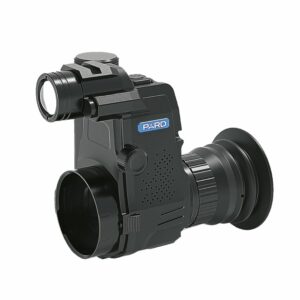
PARD NV007S (2022) - Digital night vision device (additional solution)

Rear attachment for short/medium distances – integrated focusable IR illuminator
> Attachment device that is clamped to the rear of the glass - therefore no shift in the point of impact
> Smoother/better image than its predecessor PARD NV007a
> Range up to 100m
The PARD NV007s was presented in the summer of 2021 and the hunters' requests for improvements compared to its predecessor were included. The design has changed (note: some repeating rifles hit the device), the equipment has remained largely the same. The bigger difference to its predecessor is the significantly smoother and slightly better image PARD S. The bullet resistance should also be taken into account. In the predecessor, this was specified as up to 5.000J PARD S only up to 3.000J, which is a problem for some calibers.
Tip: Use a Speed Uni adapter for mounting to allow for flexible mounting of the device on optics.
PARD NV007SP & LRF (2023) - Digital night vision device (add-on solution)

Rear attachment for short/medium distances – integrated focusable IR illuminator
> Attachment device that is clamped to the rear of the glass - therefore no shift in the point of impact
> Successor of PARD NV007SP
> Significantly larger objective lens than its predecessor
> certified up to 6.000J
> continuous recording in video loop (pulse controlled)
> Range up to 100m
The PARD NV007SP is the next evolution, developed from the NV007s. The case has been improved in detail. The battery compartment is located on the left side (previously on the right), which allows repeating rifles with a larger opening angle to be used. IR illuminator now adjustable in relation to the focus point (this was not the case before). A new sensor with higher resolution ensures a better image (noticeable!). As usual, the device is available in two different versions (940nm for those who are shy Wild, 850nm for normal Wild).
The laser range finder is also NEW – the distance to the target can be determined at the touch of a button. Helpful, especially for unknown areas and when using thermal imaging handheld devices (with which it is often a little more difficult to estimate distance.
It is also important that the new PARD is now approved by the manufacturer up to 6.000J and is therefore significantly higher than its predecessor.
Sytong HT-66 - Digital night vision device (additional solution)

Rear attachment for short/medium distances – integrated focusable IR illuminator
> Attachment device that is clamped to the rear of the glass - therefore no shift in the point of impact
> Extremely inexpensive
> Range up to 100m
The Sytong HT-66 is an add-on device based on the PARD NV007A and will be launched in 2021. Previous videos indicate good performance and improvement in contrast to PARD hope. The performance with the IR brightener switched off is said to have improved significantly. A Sony CMOS sensor is installed, which, in conjunction with a faster processor, should offer less delay in the image (during rapid movements and changes in brightness). The adapters should be between PARD and Sytong be interchangeable.
Sytong HT-88 - Digital night vision device (additional solution)

Rear attachment for short/medium distances – integrated focusable IR illuminator
> Attachment device that is clamped to the rear of the glass - therefore no shift in the point of impact
> Improved sensor
> New compact body
The Sytong HT-88 is the successor to the HT-66. It comes with a new control unit, revised housing and more powerful sensor technology. The lens construction is also new to the device. An LRF variant has not yet been announced. The Sytong HT-88 is also expected to be launched in the Vatiante HT-880 (without IR brightener).
Pulsar FN455 / F455 / FN455s night vision attachment (digital technology)
HIKmicro Cheetah HIKmicro Cheetah C32F / C32FN & with LRF C32F-L / C32F-NL (Digital Technology)

Attachment device for medium distances – Intelligent IR illuminator that regulates its own power output
First digital attachment from HIKmicro
> Intelligent IR brightener
> Extremely high-resolution sensor: 2.560 x 1.440 pixels
> Optionally also with LRF laser range finder (“L” variant)
> Secure applications up to a range of 175m
> Observation range up to 450m (optimal visibility)
The HIKmicro Cheetah is a newly developed (to be presented at the end of 2022) digital night vision attachment from HIKmicro. It is the first clip-on (attachment) from the manufacturer and comes in 4 versions, which differ in the radiator and the function of the laser rangefinder. The Cheetah is equipped with a very high-resolution sensor (2.560 x 1.440 pixels), which has a significantly higher resolution than other digital night vision devices on the market. What is also special about the Cheetah is the intelligent IR brightener, which is automatically regulated and thus counteracts crossfades. The variants available for the German market are as follows:
> 850nm (for areas without redwild), without rangefinder: Hikmicro Cheetah C32F
> 940nm (for areas with redwild), without rangefinder: Hikmicro Cheetah C32F-N
> 850nm (for areas without redwild), with rangefinder: Hikmicro Cheetah C32F-L
> 940nm (for areas with redwild), with rangefinder: Hikmicro Cheetah C32F-NL
Tube night vision devices
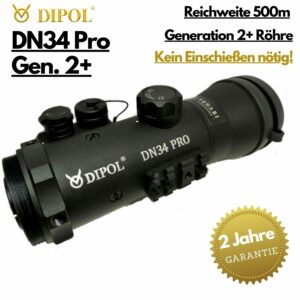
Dipole DN34 Pro Gen. 2 - night vision attachment (tube technology)

Attachment device for short/medium distances
> Proven technique - used by many hunters
> inexpensive, robust & durable
> Secure applications up to a range of 175m
> Gen. 2+ image converter tube
> Up to 54LP/mm
The Dipol DN34 Pro with Generation 2+ image intensifier tube is a very popular night vision attachment. It is one of the best-selling Dipol image intensifier tube night vision attachments, and for good reason. Robust and proven technology, simple operation, and effective ranges of up to 175m are possible – provided the appropriate illuminator is used. Note : Dipol uses very clean image intensifier tubes – we have never found any inclusions or other defects in them!
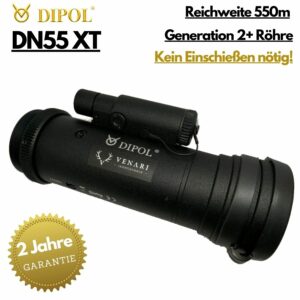
Dipole DN55 XT - night vision attachment (tube technology)

Attachment device for short/medium distances
Proven technique - used by many hunters
> inexpensive, robust & durable
> Secure applications up to a range of 200m
> Gen. 2+ image converter tube
> Approx. 50 LP/mm
The DN55 XT is the successor to the DN34 series from Dipol. The technical basis of the devices is similar, although the DN55 XT has a more compact housing. In terms of performance, the DN55 XT did not have to make any compromises. The device is equipped with a Gen. 2+ tube that resolves to approx. 50Lp/mm. The range (response) is around 200m depending on the conditions in good conditions Wild. Important notes: Dipol uses very clean picture tubes - we could never Find inclusions or other flaws in the picture tubes!
Jahnke DJ-8 NSV (1x48 & 1x56) - night vision attachment (tube technology)

Attachment device for short to medium distances
> Solid device from Germany
> PHOTONIS picture tube
> Magnesium lens
> 56mm lens
> External focus
The DJ-8 NSV is an old acquaintance on the market for night vision attachments in Germany. While it was often sold in its different variants in recent years, it is now less in demand. The DJ-8 can be ordered with a 56mm and 48mm lens. Different power classes are used for the tubes. Some of the tubes are more likely to be classified at the lower performance level (performance class 1, s/n 14-22). Performance class 2 (s/n 21-25) is in the middle of the performance scale for image converter tubes. As alternatives we recommend dipole DN34 / DN55 as well as the D-529 from Gun-Tec.
Dedel 555 Gen. 3+ - night vision attachment (tube technology)

Attachment device for particularly long distances
> High-performance device with Generation 3+ tube from KATOD
> Light amplification up to a factor of 45.000
> Particularly strong in terms of light and contrast
> more than 64 LP/mm
The Dedal 555 is a new development from Dedal and was launched in 2021. The attachment is equipped with an image converter tube of the latest generation (3+ / III+), which enables an extremely high light amplification of up to 45.000 times without impairing the contrast. The 555 from Dedal is a tube attachment for hunters who want to work without IR illuminators and also want to be able to hunt at long distances. It is therefore also suitable for areas with a high field share. A special feature of the 555 is the ability to correct hit points (e.g. because the device fell down) independently, i.e. without a specialist workshop. In an emergency, the two axes can be adjusted using adjustment screws, so that the device always remains operational.
Lahoux LV-81 - night vision attachment (tube technology)

Attachment device for particularly long distances – ECHO+ PHOTONIS image converter tubes of the highest quality!
> Highest performance among night vision attachments
> PHOTONIS ECHO+ tubes
> up to 2.000 FOM
> Signal-to-noise ratio up to over 30!
> Approx. 64 LP/mm
The LV-81 is one of the most powerful night vision scopes on the civilian market. Lahoux manufactures the devices in the Netherlands and uses particularly high-quality tubes from PHOTONIS. Even the most powerful PHOTONIS tubes can be ordered as an option: ECHO+ tubes with different FOM values (max. 2.000!). Lahoux is the only manufacturer that uses PHOTONIS tubes of this quality and is therefore aimed at particularly ambitious hunters. The advantage of an LV-81 with such a good tube is that you can operate the device for a very long time without a brightener, since it can work with much less residual light than most other attachments. The LV-81 not only convinces with its brightness but also with its outstanding contrast value.
Summary: Key takeaways about intuitive eating
There are many night vision attachments for hunters on the market. In this report you have seen a selection of professional devices that currently by many hunters be used. The choice of the right device is subject to a number of factors. From our point of view, the following topics are important:
When choosing your night vision device, ask yourself the following questions:
1) What hunting distances and typical weather conditions prevail in my hunting ground throughout the year (rain, fog, etc.)?
2) Do I want a “real image” (tube), an “almost real image” (digital) or a “thermal interpretation” of the environment (thermal image) for my night vision?
3) What budget do I have available? (Digital night vision is the cheapest entry into the world of night hunting)
Do you have any questions or would you like personal advice about the devices? Feel free to contact us by phone ( +49 441 923 299 470 ) or via the chat function (bottom right of the screen). We will get back to you shortly!
Discontinued devices & series

Rear attachment for short/medium distances – integrated focusable IR illuminator
> THE PARD WILL NOT BE PRODUCED - It will be through this PARD NV007V replaced
> Attachment device that is clamped to the rear of the glass - therefore no shift in the point of impact
> Extremely inexpensive
> Range up to 100m
The PARD NV007a in its second generation is a digital add-on solution for mounting on the back of the optics. The advantage of an additional solution is the exclusion of a deviation from the meeting point. The disadvantage is that the device is built backwards and the eye relief - depending on the weapon, mounting and glass - is too small. The device itself has a wide range of features (video recorder, WLAN, various setting options) and has an integrated IR brightener (please note the legal situation in Germany!). The purchase is permitted without a permit.
The attachment is suitable for hunting at short and medium distances with good visibility. The spotlight can be adjusted in intensity and light cone size. Some hunters are bothered by the structure of the optics to the rear.
Tip: Use a Speed Uni adapter for mounting in order to be able to mount the device flexibly on optics.

> successor of PARD NV007a > Revised software for smoother picture and better display > Available in 850nm and 940m version (affects the wavelength of the IR illuminator)The PARD NV007V is the revised version of the PARD A, which is very widespread in Germany. PARD has a lot of the feedback from hunters PARD A made as a basis for improving the device. The biggest difference is the revised software, which results in smoother image display. The image of the device therefore “drags less” (less streaking) and gives the hunter an overall more agile image feeling. The PARD NV007V is therefore a serious alternative to other digital add-on solutions on the market. Advantage of PARD A and the current one PARD V is also the quite high release for the shot load (up to 5.000 joules), which means that large calibers can also be used. Tip: Use a Speed Uni adapter to mount the device flexibly on optics.

Clip-on device for medium distances – very good image quality and consistently positive experiences from our customers!
> Compact device with good quality
> Very good value for money
> Secure applications up to a range of 175m
> Observation range up to 500m (optimal visibility)
The D400 DNS from Dipol is, as usual from Dipol, a particularly robust night vision attachment with a CMOS photo sensor (752 x 576 pixels), 50mm lens and a screen with a resolution of 1.024 x 768 pixels. Don't be fooled by the rather low sensor resolution - the image of the D400 DNS is breathtakingly good. The device is very well pre-adjusted, so that no adjustments to the point of impact usually have to be made.
Value for money tip : We have nothing but positive things to say about the D400 DNS. The picture quality is excellent and virtually indistinguishable from a solid CRT projector. We highly recommend this device. At this price, and even including the projector, it's a very good choice.
More information about night vision devices
Where is hunting with night vision devices allowed?
Please familiarize yourself with the current legal regulations regarding clip-on devices for hunting, both in terms of the Weapons Act (WaffG) and the state hunting laws in your respective federal state. Purchasing these devices is permitted without a license in Germany. Hunting is allowed in most federal states; however, the use of firearm-mounted IR illuminators in conjunction with a clip-on device is generally not permitted.
Functionality of residual light intensifiers with image converter tubes
Residual light amplifiers amplify existing residual light, as the name already suggests. Light particles, so-called photons, which are present through the light from the moon, from stars or through light emissions at night, are made visible to the human eye. These light particles travel in wavelengths that are visible to humans, but also in wavelengths that are not visible to humans. The light in the wavelength range that the human eye cannot see is in the so-called infrared light wave range (IR). From a wavelength of approx. 700 nanometers (nm), humans can no longer recognize light as light. Night vision technology captures the faint residual visible light that is present and non-visible infrared light, amplifies it electronically so that the human eye can perceive it.
All technologies are briefly presented below.
- Weak residual light and infrared light (photons) enter through the lens.
- The photons hit a very light-sensitive surface called the photocathode. The photocathode further breaks down the photons into subatomic particles called electrons.
- The electrons now hit a photocell. It amplifies and multiplies each electron. This means that many more electrons leave the photocell than they "entered".
- The electrons that have left the photocell hit a phosphor screen, similar to the screen of an old-fashioned television. When the electrons hit the phosphor, they create tiny flashes of light that the human eye perceives as pixels that make up the overall picture.
- Fluorescent screens are based on phosphors which light up when electrically excited. Both green and white phosphor phosphor screens are available on the market, which display the image to be viewed in green or black and white. The choice of the image color depends on the personal preference of the user.


