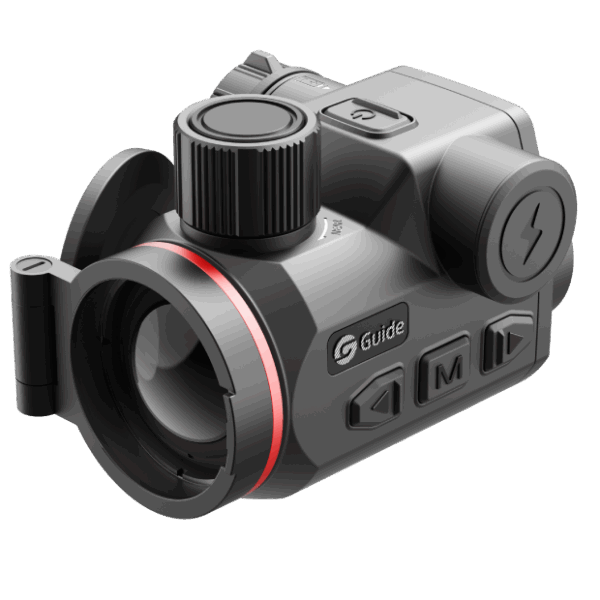
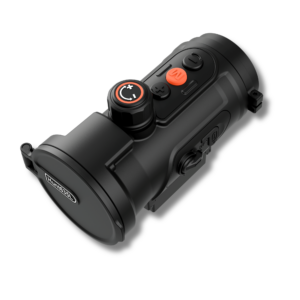
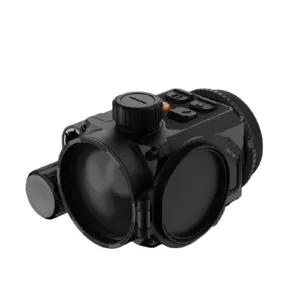
Thermal imaging attachments (also "Thermal imaging intent”) are night vision devices that use thermal imaging technology Wild or other heat sources visible at night and during the day. Thermal imaging devices come in the civilian market as hand-held devices (often Thermal imager mentioned) or as attachments.
Thermal imaging attachments
Thermal imaging devices that can be mounted onto an optical system (rifle scope, SLR camera, binoculars, spotting scope) are called clip-on devices. The clip-on device captures the heat signature of the target object. The eye, in turn, looks through the lenses of the optical system at the monitor of the thermal imaging clip-on device. By mounting the thermal imaging device in front of the optical system, the eye looks at the monitor of the clip-on device instead of directly at the target object.
Attachments in connection with a target optics
For hunting at dusk, the thermal imaging device is mounted on a riflescope. By precisely adjusting the thermal imaging device, the riflescope and thermal imaging device form an optical axis, ensuring that the field of view is not affected.
Advantages of thermal imaging intent over night vision
Can be used day & night
Thermal imaging has the advantage of being " day and night capable ". Thermal imaging depicts the thermal topography of the environment and not visible or invisible light.
- Visible: approx. 380nm to 750nm wavelength
- not visible (infrared) approx. 780nm to 1.000nm wavelength
Infrared-based night vision thus provides “sight at night”, whereas thermal imaging makes heat sources visible. This can happen at night or during the day. At night, the images from thermal imaging are usually even clearer, since the lack of sun allows the environment to cool down and the spectrum of the thermal topography thus drifts further apart.
No damage from daylight possible
This seems logical at first glance - the thermal image is daylight-capable and is therefore naturally not damaged by daylight. However, we would like to point out once again that (tube) night vision devices have exactly this problem. They will be damaged if you turn them on too early in the evening or morning. The reason is that they intensify the “residual light” and are damaged if there is too much light. Modern thermal imaging devices do not have this problem.
Even "hidden" targets are immediately visible
Anyone who has ever hunted with a hand-held thermal imaging device and infrared night vision on the target optics knows this situation: the thermal imaging device shows clearly when scanning the edge of the forest Wild at some distance. You put it on and look through the target optics with infrared night vision - and you hardly see anything.
Mit anderen Worten: The thermal imaging device has an easy time identifying heat sources. However, the infrared-based night vision device on the target optics must already have high performance to produce a usable image at 250m and may not be able to do this because the Wild is well camouflaged in the grass.
This is where the strength of the thermal imaging attachment comes into play: The attachment identifies the heat sources directly for the aiming optics , so that all targets are immediately visible when aiming – just like with the handheld device.
The advantages are:
- At night and days
- No damage from daylight possible (unlike night vision tube devices)
- Wild Visible even in difficult conditions (tall grass, undergrowth, possibly even fog)
Well then everything is clear: thermal image intent and nothing else - right?
Yes and no - thermal imaging is convenient and - if mounted and adjusted correctly - easy to use. However, ambitious hunters point to the image performance. Anyone who has ever had a high-quality tube night vision device on their optics knows that the image performance of a tube device is on a completely different level. You can achieve an extremely clear picture at night, just as you are used to with your optics during the day (crisp, clear and sharp) at this level with high-quality tube devices.
Magnification and image quality with thermal imaging attachments
Please note that when you use the magnification of your target optics, you are basically enlarging the image section on the monitor of the thermal imaging device. Most thermal imaging devices do not enlarge the image representation of the thermal imaging signature in order not to interfere with the optical axis and to enable a perfect shot.
If you now use the magnification of your target optics, enlarge the image section of the monitor in the thermal imaging device. This is where “the wheat is separated from the chaff”. The subjective image quality now results from the different components of the thermal imaging device: the quality and resolution of the monitor, the quality and design of the lenses, etc.) - the pure sensor and screen resolution is not the only criterion.
In other words, a device costing €3.000 and one costing €6.000 can have the same physical properties on paper. However, in practice, the subjective image quality of the devices will be completely different.
Also note your subjective image impression
We frequently observe that one hunter assesses the image quality of a device completely differently than another hunter. Subjective image quality also plays a role here. We would be happy to advise you on this .